Crypto Drainers & Wallet Drainer Scams — How Darknet Users Get Their Funds Stolen
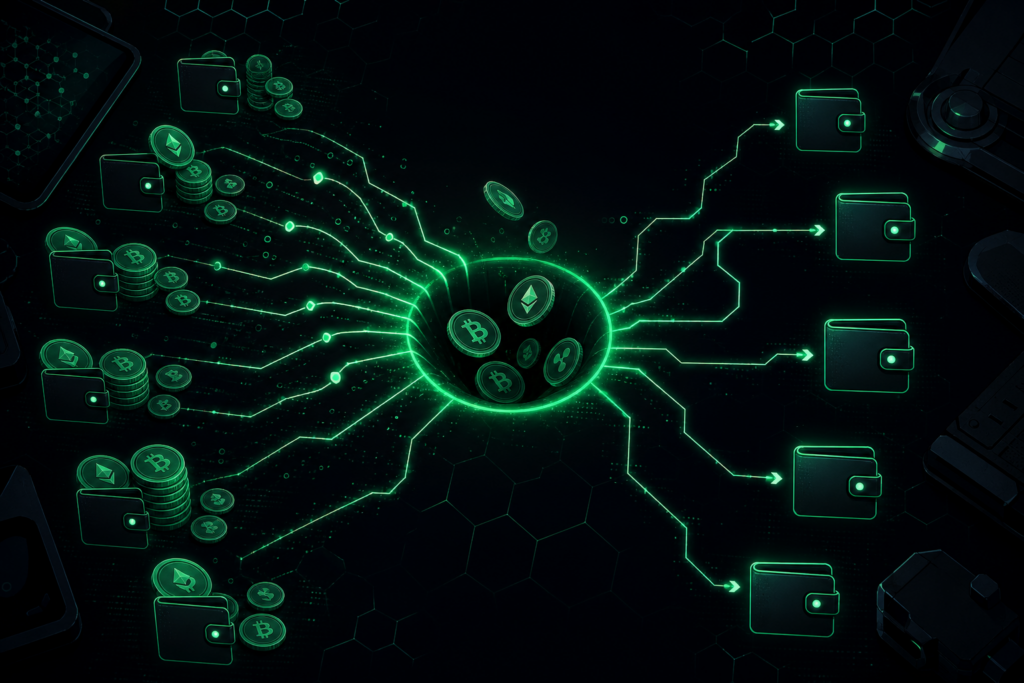
A vendor I interviewed last year kept a small spreadsheet of every phishing link that had impersonated his shop. By the end of 2024, the list stretched past 400 entries – most of them wallet-drainer kits dressed up as vendor login pages, dispute portals, or escrow release forms. One buyer I spoke with lost roughly 0.4 BTC after clicking a “finalize multisig release” link that looked almost identical to a Torzon Market escrow screen. The URL was off by two characters, the PGP signature did not verify, and the page quietly requested a token approval that emptied his hot wallet within minutes. That single incident captures exactly how drainer scams have reshaped the threat model for anyone operating on darknet markets today.
Background: From Phishing Clones to Drainer-as-a-Service
Wallet drainers did not start as a darknet phenomenon. The earliest documented drainer kits – Inferno Drainer, Pink Drainer, and Angel Drainer – emerged in 2022 on clearnet, targeting Ethereum and EVM-compatible chains through malicious smart-contract approvals. By 2023, phishing-as-a-service operators had packaged these kits into Telegram rental channels, where buyers could rent a drainer panel for a few hundred dollars per week. The pivot to darknet users came when operators realized that the same approval-based theft worked against anyone holding ETH, USDT, or even browser-based wallets used to fund Monero purchases.
On darknet markets such as DarkMatter, Nexus, and Torzon Market, drainer operators now impersonate vendor profiles, mirror login portals, and dispute resolution pages. Some clones are nearly pixel-perfect copies of the original market UI, complete with fake captchas, fake 2FA prompts, and a fake “session expired” banner that pushes the user to re-enter their seed phrase. Others mimic vendor PGP key servers, tricking buyers into encrypting shipping details to an attacker-controlled key. The evolution has been fast: where a 2021 phishing kit might simply steal a password, a 2026 drainer kit walks the victim through a chain of approvals, swaps, and bridge transactions that can drain a wallet across multiple chains before the user notices anything is wrong.
How Drainer Scams Actually Work
The technical core of every wallet drainer is the token approval. When a user connects a wallet to a decentralized application, they are usually asked to sign a transaction that grants the contract permission to move a specific token, or sometimes an unlimited amount. A drainer page abuses this by requesting an unlimited approval for a malicious contract, then calling transferFrom to sweep the balance. On darknet forums, drainer operators describe this as “one-signature theft,” and the phrase has become shorthand for the entire scheme.
Common entry points on darknet markets include:
| Torzon Market |
torzon7aphar3x4l5b77nsylgyw26kntbi4m2wemrjh72aczeh27f6qd.onion
|
| DrugHub |
drughuj7l72ig56pza77eriu7yh6qsao4xb4yasq2qfjusxzuq6rlwqd.onion
|
| DarkMatter |
darkmafmzgnsmow5z3spgludhpwxhwbg77oam433fjx3clzh2yp2oaid.onion
|
| Omega Market |
omega7yhz7n4vg4yhf2na2qaaaeatdlqvjbj2juc245mr5muxtnuvgyd.onion
|
| BlackOps |
blackoogcnxogvymmebfwfjhx4k7efpgeoeytxtsev2lc4pqlbz54qad.onion
|
- Fake vendor login pages hosted on look-alike .onion domains that harvest credentials and seed phrases.
- Dispute portal clones that ask the user to “verify wallet ownership” by signing a message or connecting a wallet.
- Escrow release forms that imitate a market’s multisig flow but route the signature to an attacker.
- Airdrop and staking dashboards advertised through Dread or Telegram channels promising free XMR or BTC rewards.
Once the approval is signed, the drainer backend – usually a rented panel from a service like Inferno or its successors – executes the theft automatically. Some kits add a layer of obfuscation by routing the stolen funds through Tornado Cash-style mixers, cross-chain bridges, or instant exchanges, which makes recovery extremely difficult. By the time a victim realizes what happened, the funds have typically been swapped into Monero or split across dozens of wallets.
Why Darknet Users Are Especially Exposed
Darknet users face a paradox: they often take stronger operational security than the average crypto holder, yet they interact with wallet software more frequently and under more pressure. A buyer on Nexus or DrugHub might connect a wallet several times a week to fund purchases, finalize escrow, or claim a refund. Each connection is a potential drainer surface. The pressure to act quickly – especially during a dispute or a time-locked escrow release – is exactly the emotional lever drainer operators exploit.
Several factors compound the risk. First, many darknet users rely on browser-based wallets rather than hardware devices, because hardware wallets are awkward to use over Tor and require dedicated software. Second, the market’s own anti-phishing guidance is often ignored in the heat of a transaction. Third, the use of Monero does not eliminate drainer risk, because most drainer kits target EVM chains, and many users still hold ETH or stablecoins to swap into XMR. A drainer that empties an ETH balance before the user has even converted to Monero is still a complete loss from the victim’s perspective.
Red Flags and Operational Defenses
The warning signs of a drainer scam are consistent across markets. A page that asks you to “connect wallet to verify” outside of a normal escrow flow is almost always malicious. A dispute form that requests a seed phrase, a private key, or a signed message containing your wallet address is a scam. A vendor who suddenly insists on moving a conversation off-platform to a wallet-verification portal is almost certainly running a drainer kit. Urgency is the universal tell: drainer operators rely on victims acting before they think.
Operational defenses are straightforward in principle and demanding in practice. The most reliable approach is to keep the wallet used for darknet purchases completely separate from any wallet holding meaningful funds, and to fund it only with the exact amount needed for each transaction. Hardware wallets configured with a dedicated drainer-protection policy – rejecting unlimited approvals and unknown contract interactions – add another layer. PGP verification of every link, mirror, and dispute URL remains non-negotiable; the Torzon Market anti-phishing guide and the Dread verification threads that circulate among Nexus and DarkMatter users both emphasize the same point. Finally, any page that asks for a seed phrase, a private key, or a signed message outside of a known-good interface should be treated as hostile, regardless of how legitimate it appears.
Market Comparison
| Market/Service | Key Features | Security Model | Best For |
|---|---|---|---|
| Torzon Market | Multisig escrow, PGP-verified mirrors, anti-phishing thread on Dread | 2-of-3 multisig with market as arbitrator | Buyers prioritizing verified links and dispute support |
| Nexus | Forced PGP for communications, vendor bond system, rotating mirrors | Centralized escrow with optional multisig | Vendors with established reputation |
| DarkMatter | Invite-only registration, XMR-native, internal wallet | Market-held escrow with dispute mediators | Users who prefer account-based markets over direct multisig |
| DrugHub | Auto-escrow, FE allowed for trusted vendors, mirror list with signed checksums | Centralized escrow, optional finalize-early | Repeat buyers with trusted vendor lists |
Current Status: Drainer Kits in 2026
The drainer ecosystem has not slowed down. Telegram-based rental panels still operate openly, advertising weekly rates and offering customer support in multiple languages. New variants target Solana and TON wallets in addition to EVM chains, and several kits now include AI-generated phishing pages that clone a market’s interface in real time. Law enforcement takedowns have been sporadic – Inferno Drainer’s operators publicly retired in 2023, but successor services filled the gap almost immediately. For darknet users, the practical consequence is that drainer scams are now a permanent feature of the threat landscape, not a passing trend.
Recovery options remain poor. Once a drainer approval is signed, on-chain transactions are irreversible, and the cross-chain obfuscation built into most kits makes tracing difficult. “Recovery service” offers that appear after a loss are themselves a well-documented secondary scam category; the watchdog-online 2026 report on the top ten crypto scam schemes lists fake investigators and “ethical hackers” as a recurring follow-on pattern. Anyone who has lost funds to a drainer should treat unsolicited recovery offers with the same suspicion as the original theft.
Conclusion
Wallet drainer scams have become the single most effective way to steal cryptocurrency from darknet users, not because the underlying technology is novel, but because it exploits the exact behaviors that darknet commerce demands: frequent wallet connections, time pressure, and trust in familiar interfaces. The defenses are unglamorous – separate wallets, hardware devices, PGP verification, and a refusal to sign anything outside a known-good flow – but they remain effective when applied consistently. The markets themselves, including Torzon Market, Nexus, DarkMatter, and DrugHub, continue to publish anti-phishing guidance and verified mirror lists, and users who treat those resources as mandatory rather than optional are the ones who tend to keep their funds. Drainer operators will keep iterating, and the only durable response is operational discipline that does not depend on any single market staying ahead of the curve.